An effective chess training plan starts with your own games. Review your recent serious games, identify the recurring weakness that costs you the most, and give that weakness the largest share of your training time. Keep a smaller amount of time for realistic application and maintenance, then reassess the plan every four weeks.
The plan must also be realistic enough to follow. A perfect schedule that lasts six days is worse than a focused schedule you can maintain for months.
The quick-start formula
If you want to build your plan today:
- Review 10 to 20 recent serious games.
- Classify the mistakes that changed the computer evaluation the most.
- Choose one primary weakness for the next four weeks.
- Reserve regular time to apply that skill in realistic positions or games.
- Keep only the minimum maintenance work needed for other important skills.
- Track completed work and recurring errors, not only rating.
- Review the evidence after four weeks and adjust.
Your schedule should not be a list of every chess subject. It should be a response to the evidence in your games.
What makes a chess training plan effective?
A strong plan is personal, focused, active, measurable, and sustainable.
- Personal: It targets your weaknesses, goals, time controls, and upcoming events.
- Focused: It concentrates on one main improvement area instead of ten resources at once.
- Active: It asks you to calculate, recall, explain, compare, and play—not only watch.
- Measurable: It tracks work completed and mistakes repeated.
- Sustainable: It leaves room for rest and for playing chess purely because you enjoy it.
Playing and training are related, but they are not identical. Online games create useful evidence and give you a place to apply skills. They do not guarantee improvement if you keep playing without analyzing why the same positions go wrong.
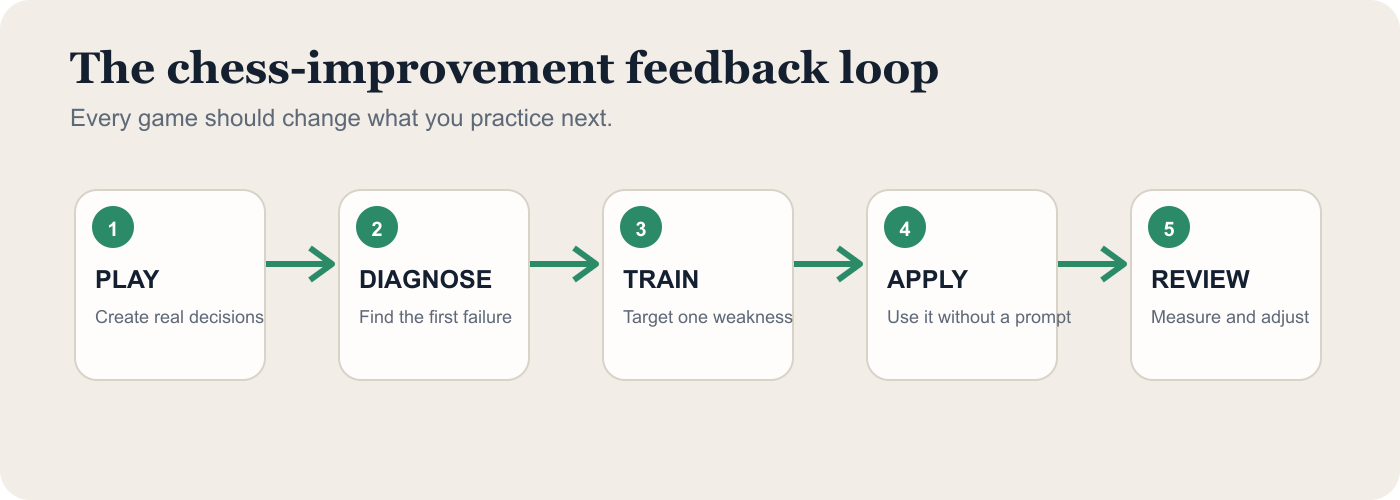
The loop is simple: play, diagnose, train, apply, review, repeat. If your plan does not contain this feedback loop, it is probably just a timetable.
Why random chess study fails
Random study often feels productive because you are constantly exposed to new ideas. The problem is that novelty is not the same as improvement.
Common examples include:
- Watching several unrelated videos without testing what you retained.
- Playing many blitz games and checking only the engine's top line.
- Studying openings when games are being lost to one-move tactics.
- Solving the same type of puzzle because you enjoy it, even though it is already a strength.
- Switching books or courses before one training block has time to work.
Your brain needs repeated, effortful contact with a skill before it becomes reliable. If pattern recognition is weak, you need consistent pattern work. If the correct moves never enter your candidate list, you need unannounced positions that force you to generate choices. If you calculate correctly but misjudge the final position, you need evaluation practice.
Be honest about whether a session is training or recreation. Both belong in a healthy chess life. Confusing the two makes it difficult to understand why your rating is not changing.
Diagnose your weaknesses before building the plan
Review 10 to 20 serious games, preferably from slower time controls. Analyze without an engine first so you can reconstruct what you thought during the game. Use an engine afterward to verify the critical moments and find tactics you missed entirely.
For every important mistake, ask:
- What did I miss?
- Why did I miss it?
- Did I know the relevant idea?
- Did the correct move enter my candidate list?
- Did I calculate the opponent's strongest response?
- Did I evaluate the resulting position accurately?
- Did time pressure, concentration, confidence, or fear affect the decision?
| Evidence from your games | Likely weakness | Useful training response |
|---|---|---|
| You repeatedly hang pieces or miss one-move tactics. | Board vision and pattern recognition | Slow safety scans and simple tactical repetition |
| You calculate one attractive move and miss a better alternative. | Candidate generation | Realistic positions with a written shortlist |
| You see the idea but lose the line in your head. | Visualization and calculation | Short lines first, then gradually deeper calculation |
| Your lines are accurate but your plans are wrong. | Evaluation and positional understanding | Compare plans in annotated games and evaluate final positions |
| You leave the opening uncomfortable in the same structures. | Repertoire understanding | Study plans, pawn breaks, and model games from your own openings |
| You fail to convert or save familiar endings. | Endgame knowledge and technique | Essential positions plus practical endgame play |
| Your process disappears when the clock is low. | Practical execution | Time-allocation rules and timed decision practice |
The first point of failure is the most useful label. If the correct move never became a candidate, calculation was not the initial problem. If you saw the line but judged its ending incorrectly, evaluation was the primary problem. The companion guide on how to stop blundering in chess explains this diagnosis in more detail.
If evaluation is the recurring weakness, use the step-by-step position evaluation framework before comparing your conclusions with an engine or model answer.
How to divide your training time
As a starting point, use a 50 / 30 / 20 allocation:
- 50% primary weakness: the skill causing the most expensive recurring errors.
- 30% transfer: serious games, realistic positions, and analysis that force you to apply the skill.
- 20% maintenance: essential tactics, openings, or endgames that would otherwise decay.
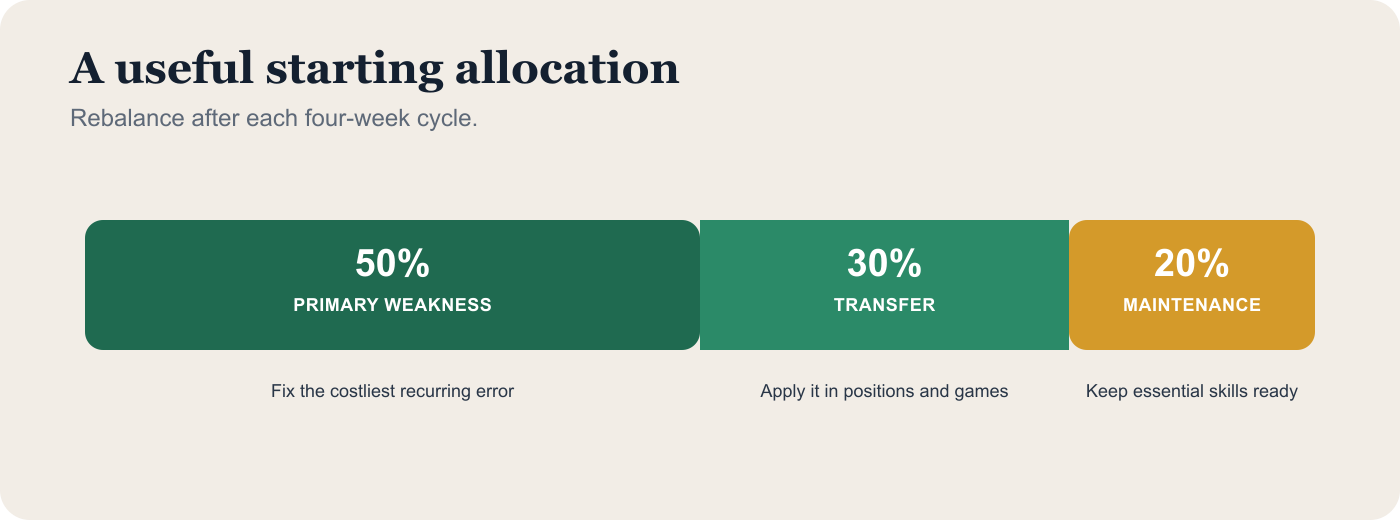
This is a coaching heuristic, not a permanent law. If you have a tournament in two weeks, opening preparation and practical games may temporarily receive more time. If you are a true beginner, pattern recognition and piece safety may need more than half. Reallocate from evidence, not guilt.
The essential components of chess improvement
You do not need to study every component equally every week, but your games will eventually expose gaps in each area.
Tactics and pattern recognition
Train common motifs until they are easy to notice: forks, pins, skewers, discovered attacks, removal of the defender, back-rank ideas, mating patterns, and loose pieces. Use easier sets for speed and recognition; use harder positions when the goal is calculation.
Calculation and visualization
Choose a candidate, calculate without moving the pieces, write or say the critical line, and compare it with the solution. Accuracy matters more than puzzle volume. Increase depth only when you can keep the current position stable in your mind.
Evaluation and middlegame understanding
Practice assessing material, king safety, piece activity, pawn structure, space, and key imbalances before looking for a move. Study annotated master games from structures you actually play, pausing at critical moments to choose a plan.
Openings
The goal is not to remember the longest move sequence. Build a narrow, playable repertoire and learn typical pawn breaks, ideal piece squares, tactical ideas, and common transitions. Use the engine to test questions, then explain the answer in your own words. Update your files from positions that appeared in your games.
Endgames
Begin with positions that recur: basic mates, king-and-pawn endings, opposition, active rook principles, and the technical endings your own games reach. Learn the method, then reproduce it from both sides without prompts.
Practical decision-making
Train with positions where you are not told that a tactic exists. Evaluate the position, generate candidates, calculate, commit to a move, and compare the complete process with a model answer. This is the purpose of the modes in the ChessMotive training guide.
A 30-minute daily chess training plan
If 30 minutes is your hard daily limit, do not squeeze every topic into every session. Rotate the work and preserve the feedback loop.
| Day | 30-minute session | Purpose |
|---|---|---|
| Monday | 20 minutes of pattern or calculation puzzles; 10 minutes logging misses | Build tactical accuracy |
| Tuesday | One 10+5 or 15+10 game; note the turning point immediately | Create realistic evidence |
| Wednesday | Review Tuesday's game without an engine, then verify the critical moment | Diagnose the real weakness |
| Thursday | 25 minutes on the primary weakness; 5 minutes of recall from memory | Target the cause |
| Friday | One or two unannounced ChessMotive positions with a written evaluation and candidates | Transfer the skill to decisions |
| Saturday | 30 minutes of opening, endgame, or strategy maintenance chosen from your games | Prevent important gaps |
| Sunday | Rest, catch up, or spend 10 minutes reviewing the week's log | Sustain the routine |
A 15+10 game may run beyond 30 minutes. If the limit is strict, use 10+5 or move the review to the next session. One carefully reviewed game is more useful than several games you immediately forget.
A 60-minute daily chess training plan
Use two kinds of sessions rather than repeating the same hour every day.
Study day
- 10 minutes: Easy pattern-recognition warm-up.
- 35 minutes: Deep work on the primary weakness.
- 10 minutes: Apply the same theme in a realistic position.
- 5 minutes: Record one mistake, one lesson, and the next action.
Playing and review day
- 30 to 40 minutes: One serious rapid game.
- 15 to 20 minutes: Self-analysis without an engine.
- 5 to 10 minutes: Engine verification and a training note.
If the game lasts the full hour, review it the next day. Do not sacrifice the analysis simply to make the schedule look tidy.
A five-hour weekly chess training plan
This version works well for a busy adult or student who can protect several focused blocks.
| Training block | Weekly time | What the block should produce |
|---|---|---|
| Serious games | 75 minutes | Positions that expose decisions under pressure |
| Self-analysis and engine verification | 60 minutes | A short list of recurring root causes |
| Primary-weakness training | 90 minutes | Deliberate practice on the highest-priority skill |
| Realistic decision training | 45 minutes | Written evaluation, candidates, calculation, and final move |
| Opening or endgame maintenance | 30 minutes | One reviewed branch or one reproducible technique |
| Weekly review and planning | 20 minutes | Next week's focus and scheduled sessions |
| Flex time | 20 minutes | Catch-up, extra analysis, or rest when needed |
Total: 300 minutes.
Case study: a two-hour daily plan for a 1400 FIDE player
One of my students at approximately 1400 FIDE could spend about two hours a day on serious work outside our coaching calls. His recurring needs included pattern recognition, a structured thinking process, opening understanding, and careful game review. The schedule therefore emphasized those areas instead of dividing time equally across all chess subjects.
| Day | Main work | Coaching purpose |
|---|---|---|
| Monday | One hour of fast but accurate tactical patterns; one serious rapid game followed by analysis | Pattern recognition plus evidence from play |
| Tuesday | One to two hours of active book study, solving every exercise before reading the answer | Calculation or conceptual understanding |
| Wednesday | Two hours of ChessMotive Foundation training; coaching call when scheduled | Candidate generation and model comparison |
| Thursday | Up to two hours building a narrow ChessBase repertoire from lines reached in his games | Opening plans, logical deduction, and practical preparation |
| Friday | Coaching call or a lighter review day | Correct the most persistent weakness |
| Weekend | Catch-up if necessary; otherwise casual play, another hobby, or complete rest | Recovery and long-term consistency |
For calculation work, suitable examples include *Think Like a Super-GM* by Michael Adams and Philip Hurtado. For repeated tactical pattern training, *The Woodpecker Method* by Axel Smith and Hans Tikkanen provides a structured system. The important point is not to collect both books immediately; choose the resource that matches the diagnosed weakness.
This schedule is an example, not a universal prescription. A 1400 player who already sees tactics well but consistently misplays rook endings should receive a different plan.
How I train as an active International Master
My own plan illustrates why copying a stronger player's schedule can be misleading.
I have spent periods of my career solving puzzles for many hours a day. That work made calculation and pattern recognition relative strengths. At present, my weaknesses include opening preparation, practical decision-making, confidence in unfamiliar positions, and parts of positional play. My training therefore gives substantial time to analyzing openings and building ChessBase files from the positions I expect to reach.
I do not allocate equal time to calculation simply because calculation is important in chess. The plan reflects what currently limits my results. Your plan should do the same.
Adapt the plan by rating
Ratings differ across FIDE, Chess.com, and Lichess, so treat these bands as rough starting points. Your game audit takes priority.
| Approximate level | Main emphasis | Keep it practical by... |
|---|---|---|
| 800–1100 | Piece safety, board vision, elementary tactics, opening principles, basic mates | Using slow games and a safety check before every move |
| 1100–1400 | Pattern recognition, candidate moves, short calculation, basic endgames | Writing candidates before solving and reviewing every serious loss |
| 1400–1600 | Visualization, evaluation, recurring pawn structures, repertoire understanding | Studying positions from your own games and comparing plans |
| 1600–1800 | Selective calculation, deeper evaluation, practical time use, technical endings | Training the narrow root cause under timed conditions |
| 1800+ | Individual bottlenecks, tournament preparation, deep analysis, psychological objectivity | Using a mistake database and longer focused blocks |
Do not treat crossing a rating boundary as permission to abandon fundamentals. Strong players still miss simple tactics; they simply need a more precise diagnosis of why the miss occurred.
How to complete a high-quality training session
Whatever skill you train, the session should make you think before it shows you the answer.
Use this structure:
- Set one objective. “Improve rook-endgame technique” is clearer than “study endgames.”
- Attempt before consuming. Calculate the position, recall the line, or explain the plan before reading or switching on the engine.
- Commit to an answer. Write the move, variation, evaluation, or rule you believe is correct.
- Compare with a model. Identify the first point where your reasoning diverged.
- Explain the lesson. Reduce the difference to one reusable idea.
- Create transfer. Find or play a related position without being told which idea applies.
- Log the next action. Decide whether to repeat, increase difficulty, or change the focus.
Concentration is a limited resource. A focused 35-minute block followed by a short break can be better than two unfocused hours. Stop when answer quality collapses; endurance itself should be increased gradually.
How to measure whether the plan is working
Rating is important, but it is delayed and noisy. Track leading indicators that tell you whether the process is changing.
| Measure | Review frequency | What improvement looks like |
|---|---|---|
| Planned sessions completed | Weekly | The schedule is realistic enough to sustain |
| Serious games self-analyzed | Weekly | More games produce a written lesson |
| Recurring root-cause errors | Every 10–20 games | The target category appears less often or costs less |
| Calculation accuracy | Per training set | More complete lines and fewer missed defensive moves |
| Candidate quality | Per realistic position | The best move enters the shortlist more consistently |
| Time usage | Per serious game | More time remains for critical positions |
| Rating and tournament results | Monthly or quarterly | The training transfers under competitive conditions |
Some skills transfer faster than others. A familiar tactical pattern may appear in your next game. A better evaluation process may take longer because it must interact with candidate generation, calculation, and time management on every move.
If the work is consistent but the target mistake is not changing, ask whether the exercise resembles the game decision closely enough. Knowledge that never appears without a prompt has not yet become a practical skill.
A four-week chess improvement program
Use a four-week cycle to keep the plan focused without becoming rigid.
| Week | Focus | Required output |
|---|---|---|
| Week 1: Audit | Review 10–20 games and choose one root cause | Baseline count, example positions, and one priority |
| Week 2: Build | Train the priority with deliberate, untimed work | Accurate repetitions and written explanations |
| Week 3: Transfer | Apply the skill in unannounced positions and serious games | Evidence that the skill enters your decisions |
| Week 4: Test and adjust | Repeat comparable positions and review new games | Keep, narrow, or replace the focus for the next cycle |
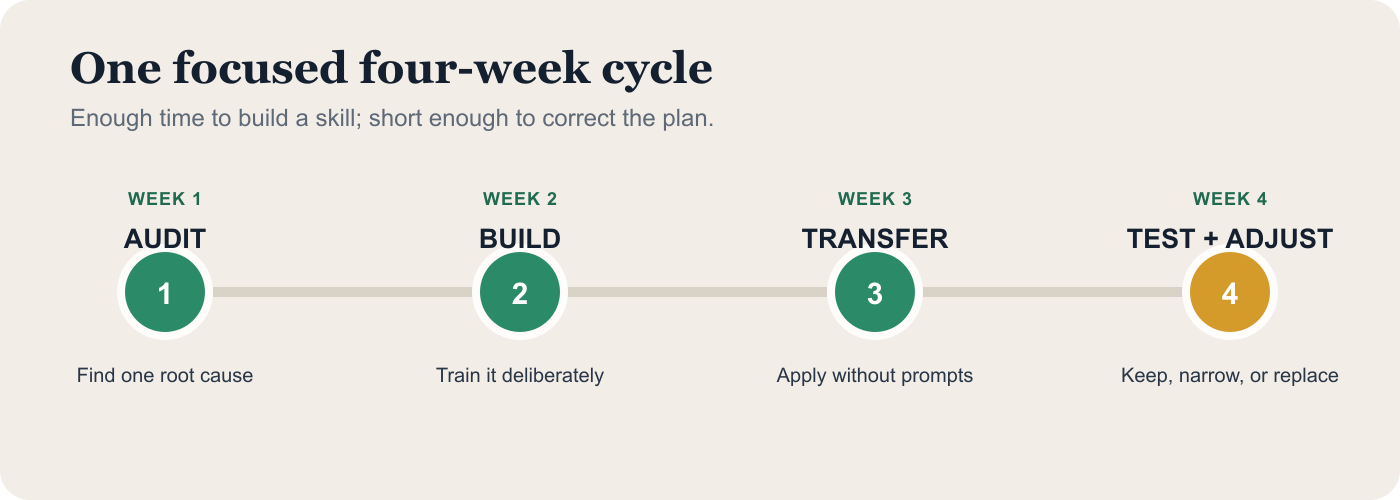
Do not change the plan because one session felt difficult. Change it when the evidence shows that the activity is too easy, too hard, irrelevant to your games, or impossible to maintain.
Common chess training-plan mistakes
Mixing improvement and entertainment
Passive videos and casual blitz can be enjoyable. They become a problem only when you count them as deliberate practice and then wonder why a specific weakness remains.
Fix: Label sessions “work” or “play” before you begin. Protect both.
Building a schedule you cannot maintain
Missing a day is normal. Repeatedly missing the same block means the plan does not fit your life.
Fix: Reduce the minimum session until it is realistic, schedule a catch-up block, and resume at the next planned time instead of trying to repay a growing debt.
Training only your strengths
Strong activities feel rewarding. I experienced this with puzzles: improving an already high tactics rating felt productive while more important weaknesses received less attention.
Fix: Give the largest block to the weakness that costs the most points, even if another activity is more enjoyable.
Using too many resources
Each new book or course creates setup time and another unfinished thread.
Fix: Use one primary resource per target skill for the full four-week block. Add another only when the first cannot provide the practice you need.
Letting the engine replace thinking
The engine can identify mistakes instantly, but copying its top line does not explain why you missed the move.
Fix: Analyze first, use the engine to verify, and write the human cause in one sentence.
Measuring only rating
A short losing streak can hide good training; a winning streak can hide repeated bad decisions.
Fix: Track behaviors and root causes weekly, then use rating as a longer-term transfer measure.
Frequently asked questions
How much chess should I train each day?
Thirty focused minutes can be useful if the plan is consistent and includes serious games and review across the week. More time helps only while the quality of attention remains high. Choose the smallest schedule you can follow reliably, then expand it.
What should a beginner study first?
Prioritize piece safety, board vision, elementary tactical patterns, opening principles, and basic checkmates. Play slower games and analyze the moments where material was lost. Avoid spending most of your time memorizing opening lines.
How do I identify my biggest weakness?
Review 10 to 20 serious games and classify the first cause of each costly mistake. Count the recurring categories. If you cannot distinguish candidate-generation, calculation, and evaluation errors, work with a qualified coach or compare your written thinking with detailed model explanations.
How often should I change my training plan?
Review it briefly every week and make a larger decision every four weeks. Change the focus when the target mistake has improved, another problem has become more expensive, or the current exercise is not transferring into games.
What if I have no motivation to train?
Lower the starting requirement. Commit to the first 10 focused minutes, keep the material ready, and begin at a scheduled time rather than waiting to feel motivated. If burnout keeps returning, reduce the weekly load and protect complete rest days.
Should I hire a chess coach?
A coach is most valuable when you cannot diagnose your own mistakes, choose suitable exercises, or judge whether the plan is transferring. You can still build an effective self-study plan if you analyze honestly, use detailed resources, and revise the plan from evidence.
Start with one training cycle
Do not wait for the perfect schedule. Review your recent games, choose one recurring weakness, and run a four-week cycle. At the end, keep what transferred and replace what did not.
When you want to practice the complete decision process—evaluation, candidate moves, calculation, commitment, and comparison with a professional model—start a ChessMotive training session.