To stop blundering in chess, do two things consistently: use a short safety routine before you move, then diagnose the real cause of every serious mistake after the game. The cause may be poor board vision, weak pattern recognition, incomplete candidate moves, inaccurate calculation, faulty evaluation, time pressure, or a lapse in concentration. Each cause requires different training.
The five-step anti-blunder routine
Before every serious move:
- Ask what changed. What did the opponent's last move attack, defend, open, close, or leave behind?
- Scan the opponent's forcing moves. Check their checks, captures, and immediate threats before returning to your own plan.
- Generate candidates. Compare at least two reasonable moves in a critical position instead of trusting the first attractive idea.
- Calculate the best reply. Assume your opponent will choose the most challenging response—not the reply you hope to see.
- Run a final safety check. Imagine your move played. Check the destination square, the square your piece left, newly opened lines, and every forcing reply.
This routine will not eliminate every mistake. Even world champions blunder. It will reduce preventable errors and make the remaining ones easier to understand.
The quickest useful question is: If my opponent could move again right now, what would they play?
Why do you keep blundering? Use this diagnosis first
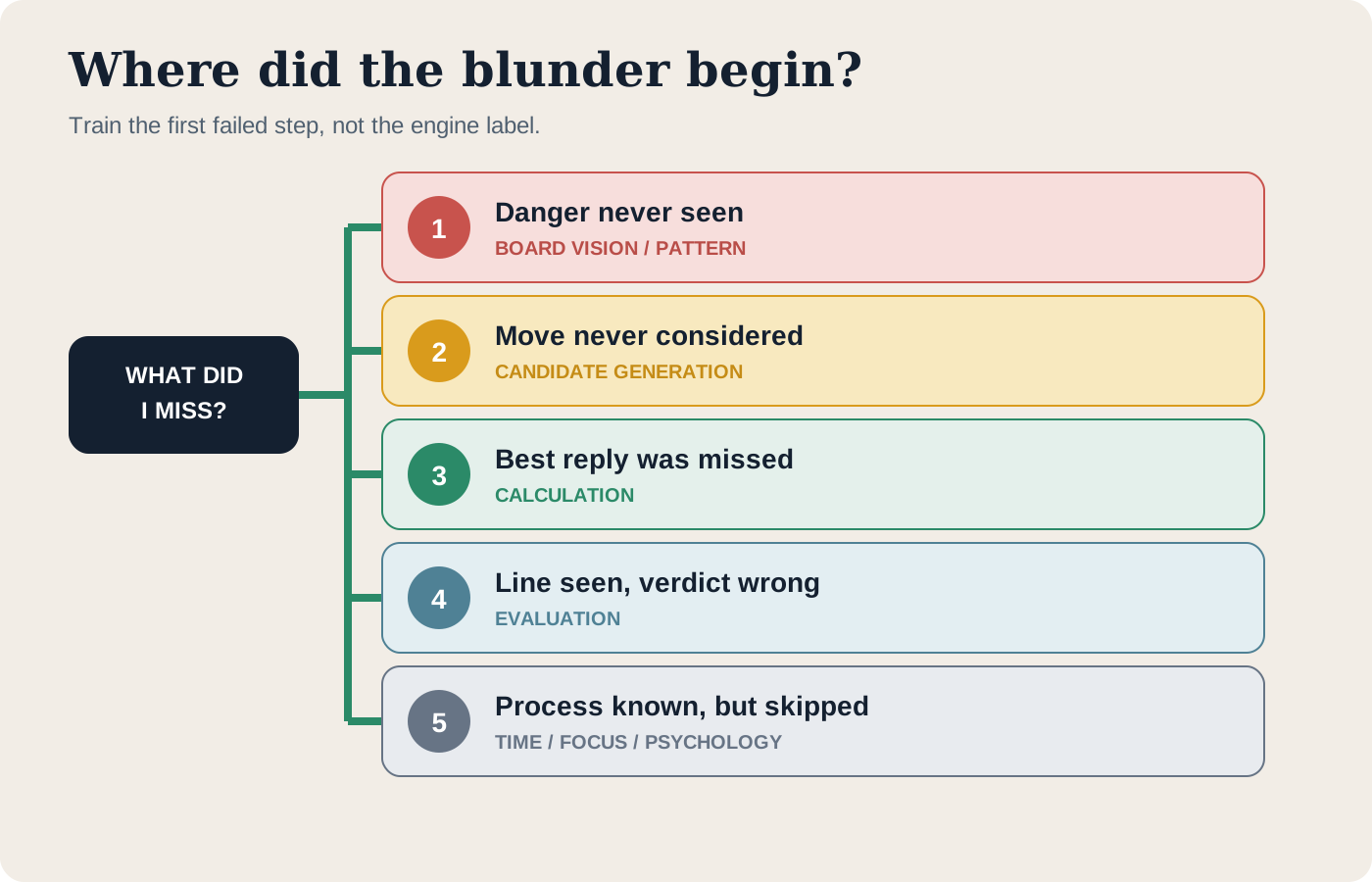
Do not label every mistake “bad calculation.” Use the first point at which your thinking failed.
| What happened? | Likely root cause | What to train |
|---|---|---|
| You never noticed an attacked or undefended piece. | Board vision or pattern recognition | Slow threat scans and simple tactical patterns |
| The correct move never entered your candidate list. | Candidate generation | Structured move-finding from unannounced positions |
| You considered the move but missed the opponent's reply. | Calculation or visualization | Short, forcing lines with the opponent's best defense |
| You calculated the line correctly but judged its final position badly. | Evaluation | Material, king safety, activity, pawn structure, and imbalances |
| You knew the right process but skipped it. | Practical execution | Time management, concentration, and a shorter routine |
| You became passive, reckless, or rushed because of the opponent or result. | Psychology | Objective board-based cues and a reset routine |
What is a blunder in chess?
A blunder is a move that significantly worsens your position. It may lose material or allow checkmate, but not every blunder is a one-move tactic.
Blunders can be:
- Tactical: missing a forcing move, hanging material, or allowing mate.
- Positional: placing a piece badly or creating a lasting weakness.
- Conceptual: choosing the wrong plan because you misunderstood the position.
- Calculational: overlooking an important move inside a variation.
- Practical: wasting time, entering needless complications, or choosing a line that is too difficult to handle.
- Psychological: allowing fear, frustration, or overconfidence to distort your judgment.
The distinction matters. Solving more forks will not fix an evaluation error, and memorizing a longer checklist will not fix poor time management.
Step 1: Read the opponent's last move
Many blunders begin because a player keeps following a plan that belonged to the previous position. Treat every opponent move as new information.
Ask:
- What is attacked now that was not attacked before?
- Which piece or pawn became defended?
- Did a file, rank, or diagonal open toward either king or a valuable piece?
- What did the moved piece stop defending?
- Which square became available when the piece moved away?
This scan catches direct threats, discovered attacks, removed defenders, and tactical ideas created by a change in the pawn structure. It also prevents “autopilot chess,” where you continue your own idea without checking whether the position still permits it.
Step 2: Check forcing moves—for your opponent first
Checks, captures, and direct threats narrow the position quickly. Look at the opponent's forcing moves before your own.
You do not need to calculate every legal check or capture to the end. Notice each one, reject the obviously irrelevant moves, and investigate the dangerous candidates. The purpose is to stop a forcing reply from remaining invisible.
Pay special attention to:
- Checks that drive your king into a tactical net.
- Captures on loose or overloaded pieces.
- Zwischenzugs—forcing moves inserted before an expected recapture.
- Tempo attacks on your queen or an important defender.
- Pawn moves that open a line toward your king.
Safety gives you permission to return to strategy. A beautiful positional idea is irrelevant if the opponent already has a winning check or capture.
Step 3: Separate candidate generation from calculation
Many players calculate the first move that catches their attention and never compare it with a safer or stronger alternative. This is not only a calculation problem; it is a search problem.
In a critical position, create a shortlist of two or three moves. A candidate belongs on the list because it is forcing, necessary, positionally useful, or simply plausible enough to test. It does not need to be good yet.
Then compare the candidates using the same questions:
- What is the opponent's strongest response?
- What forcing continuation follows?
- What position remains when the forcing line ends?
- Which candidate is easiest to play if several moves are objectively similar?
ChessMotive training is built around this separation: first understand the position and generate candidates, then commit to a move and compare your process with a professional solution.
Step 4: Calculate the opponent's strongest response
Calculation is the ability to visualize future positions and compare variations without moving the pieces. The most important habit is adversarial: assume your opponent will find the reply that creates the most problems.
For each serious candidate:
- Play the move mentally.
- Look for the opponent's checks, captures, and threats.
- Choose their most challenging reply.
- Continue until the forcing sequence settles.
- Evaluate the final position instead of stopping at the last tactical move.
Beginners should start with short lines of one to three moves. Stronger players need deeper and more selective calculation, but the discipline is the same: do not stop a line because it becomes uncomfortable.
Step 5: Perform a final safety check
Once you have chosen a move, imagine the piece on its destination square and its original square empty.
Check four things:
- Destination: Can the moved piece be captured or trapped?
- Origin: What did the piece stop defending?
- Lines: Did the move open a file, rank, or diagonal?
- Reply: What is the opponent's most forcing response now?
Keep this final check short. It is a verification step, not a second full calculation. In time trouble, compress it to: opponent check, opponent capture, loose piece, move.
The skills behind fewer blunders
Board fluency and tactical patterns
Piece movement, attacks, and basic tactical patterns must become easy to recognize. If you still reconstruct a knight's movement slowly, that consumes attention that should be available for threats and calculation.
Build automatic recognition of forks, pins, skewers, discovered attacks, mating patterns, back-rank weaknesses, loose pieces, and overloaded defenders. Pattern recognition does not replace calculation; it tells you what deserves calculation.
Chess understanding and evaluation
You can calculate accurately and still choose the wrong move if you misunderstand the position. Before searching, assess:
- Material balance.
- King safety.
- Piece activity and the least useful piece.
- Pawn weaknesses and pawn breaks.
- Space and important squares.
- The main imbalances.
- What each side is trying to achieve.
Principles such as development, king safety, and improving the worst-placed piece guide your candidate list. They are not rules that override concrete calculation.
The companion guide on how to evaluate a chess position develops this comparison into a practical step-by-step method.
Practical execution
Some mistakes occur even when you possess the required chess skill. You may rush because the move looks obvious, relax in a winning position, play passively against a stronger opponent, or spend so long on simple decisions that the next critical position arrives in time trouble.
Good practical play means recognizing when a position deserves extra time. Slow down when:
- The opponent makes an unexpected move.
- The pawn structure or king safety changes.
- Several forcing moves exist.
- A move appears obviously winning.
- You are about to simplify into an endgame.
Why solving more puzzles may not stop your blunders
Most tactics puzzles announce that a tactical solution exists. A real game does not. You may calculate accurately after being prompted and still fail to notice that an ordinary-looking position has become tactical.
To improve transfer from puzzles to games:
- Use positions where the answer may be tactical, positional, or defensive.
- State your evaluation and candidate moves before calculating.
- Solve from both the attacking and defending side.
- Record why you missed a move, not only whether your answer was correct.
- Revisit positions from your own games.
The objective is not to guess more first moves. It is to reproduce the decision process you need at the board.
A famous example: Kramnik's mate-in-one blunder
In the second game of the 2006 match between Deep Fritz and Vladimir Kramnik, Kramnik reached the position on the left after 34.Nxf8. He played 34...Qe3??, focusing on a favorable queen trade and his advanced queenside pawns. Deep Fritz answered 35.Qh7#, shown on the right.
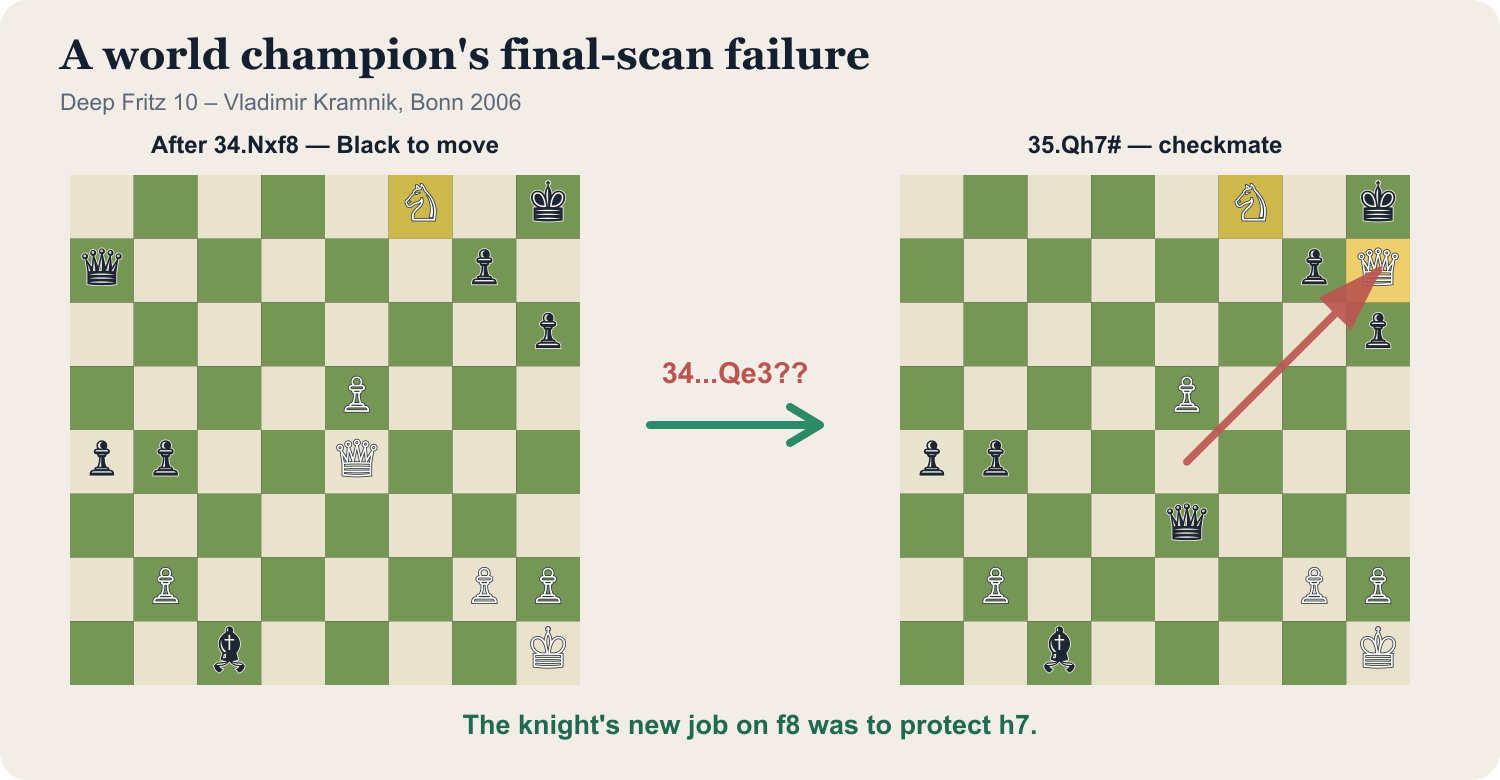
The lesson is not that a world champion lacked calculation ability. The move 34.Nxf8 changed the position by placing the white knight on an unusual square from which it protected h7. A final scan of White's checks after 34...Qe3 would have revealed the mate.
This example is valuable because it removes a common excuse: blunders are not limited to beginners. A strong analytical process can still fail when one board fact never enters attention. The game and contemporary explanation are documented by ChessBase.
What should you train first at your level?
Rating bands are only rough guides; your own games are better evidence. Use these priorities when you do not yet have enough data.
| Player stage | Common failure | First priority | Best practice format |
|---|---|---|---|
| Beginner or casual player | Hanging pieces and missing one-move threats | Board vision, piece safety, and elementary patterns | Slow safety scans and short tactical positions |
| Club player | Inconsistent candidates and incomplete calculation | Candidate generation, visualization, and evaluation | Unannounced positions with written lines |
| Serious tournament player | Interaction of calculation, evaluation, time, and psychology | The weakest component revealed by recent games | Deep analysis, model comparison, and tournament simulation |
Beginners and casual players
Make piece movement, attacks, and basic patterns automatic. Before moving, ask what is attacked, what is undefended, whether the destination square is safe, and what your move stops defending.
Use the Foundation mode described in the ChessMotive training-mode guide to scan move categories and compare several plausible choices. Add short tactical work, but solve deliberately rather than guessing.
Club players
Your process is often correct in some positions and absent in others. Focus on generating candidates consistently, visualizing the opponent's best defense, and evaluating the resulting position.
After each puzzle or game, compare the whole process:
- Was the initial evaluation accurate?
- Did you understand the opponent's idea?
- Which candidate did you miss?
- Where did your calculation stop?
- Did you misjudge the final position?
Serious tournament players
At this level, a single label such as “tactics” is usually too broad. Classify whether the decisive failure was candidate generation, calculation, evaluation, knowledge, time management, concentration, or psychological objectivity.
Train the narrow failure under realistic conditions. If tournament time trouble is the problem, unlimited puzzle time will not fully solve it. If you calculate the right lines but choose the wrong one, more tactical volume may reinforce a strength while leaving evaluation untouched.
Build a personal anti-blunder plan
Review your last 10 to 20 serious games, preferably at slower time controls. Record every decision that materially worsened your position.
For each one, ask:
- What did I miss?
- Why did I miss it?
- Did I know the relevant idea?
- Did the correct move enter my candidate list?
- Did I calculate the opponent's strongest reply?
- Did I evaluate the resulting position correctly?
- Was time pressure, concentration, or emotion involved?
Group the mistakes by root cause. Your most frequent costly category becomes the focus of your next training block. A detailed chess training plan should turn that diagnosis into a realistic weekly schedule.
A seven-day anti-blunder reset
- Day 1: Review three recent losses without an engine and mark the first moment you felt uncertain.
- Day 2: Verify those moments with an engine, then classify the root cause.
- Day 3: Solve 10 simple positions slowly, using the five-step routine aloud or in writing.
- Day 4: Train the most frequent tactical or positional pattern from your review.
- Day 5: Solve two realistic positions and record your evaluation, candidates, line, and final move.
- Day 6: Play one slower game with a single goal: perform the last-move scan after every opponent move.
- Day 7: Review the game and choose one cue to carry into the following week.
Measure a specific behavior—such as “I checked what the moved piece stopped defending”—rather than the vague goal “do not blunder.”
Frequently asked questions
Can I completely stop blundering?
No. Every human player makes mistakes. The realistic goal is to reduce their frequency and severity and to stop repeating the same preventable pattern.
What should I check before every move?
Ask what changed after the opponent's move, scan their checks, captures, and threats, compare reasonable candidates, and perform a final safety check after choosing your move.
Should I calculate every check and capture?
Notice every legal forcing move, then dismiss clearly irrelevant ones quickly. The purpose is to prevent a dangerous reply from remaining invisible, not to spend equal time on every check.
Should I play slower time controls?
Yes, if your thinking process is not yet automatic. Slower games give you time to practice a new routine. Blitz can test habits you already have, but it is a poor environment for building a careful process from scratch.
Can an engine tell me why I blundered?
An engine can show the refutation and the size of the evaluation swing. It cannot automatically identify the human cause. You still need to decide whether the move was absent from your candidates, miscalculated, misjudged, or played without using the process you already knew.
The final lesson
Blundering less is not about memorizing one magical checklist. It is about building the skills and habits that make accurate decisions possible.
Start with the five-step routine. Then use your own games to identify the weakest part of your process and train that part deliberately until it survives practical conditions.