Direct answer
To find the best move, you cannot look at moves randomly and pick one from the herd. In every position, you should follow a structured thought process that gives you a much better chance of finding good moves while limiting mistakes.
You might already have a method for finding the best move, but you are likely missing some critical steps:
- Understand the position and your strategy.
- Find all reasonable candidate moves.
- Choose a move from your candidates.
- Make your final evaluation and update your strategy.
Following this structure will help you stay on track in your games, but each step requires skills that take experience to master. In Step 1, you need evaluation and conceptual understanding, which depend on fundamental principles and familiarity with different types of positions. You can read more about this in the full position evaluation framework.
In Step 2, you use the information from your evaluation to find reasonable moves and efficiently eliminate the ones that do not deserve further investigation. This can also involve board vision and pattern recognition. Step 3 requires you to determine which good move is likely to be best. It can involve deep calculation, practicality, conceptual understanding, psychology, and more. Step 4 differs from Step 1 because you can now apply the deeper evaluation and calculation completed during the selection process.
What “best move” actually means
The best move is not simply whichever move the computer suggests. Modern engines are so strong that they may evaluate a humanly unpleasant option as equal to a much easier alternative. The computer may be objectively correct, but humans cannot calculate 30 moves ahead. Our thinking capacity is limited, so we need practical simplifications that help us find the best move for a human to play.
That does not mean ignoring objective chess. It means using a disciplined process to spend your limited time on the moves and variations that matter most.
A structured thinking process with an example
I will use one of the quieter positions from ChessMotive’s training, from Jonas Buhl Bjerre against Velimir Ivic in the 2025/26 German Bundesliga. It demonstrates the full thinking process when you have many good options rather than one simple tactic.
There is no single definitive way to think through every position. The process depends on factors such as the time control, the complexity of the position, and psychology. For this example, I will demonstrate the most complete application of the method: classical time control with no immediate practical pressure.
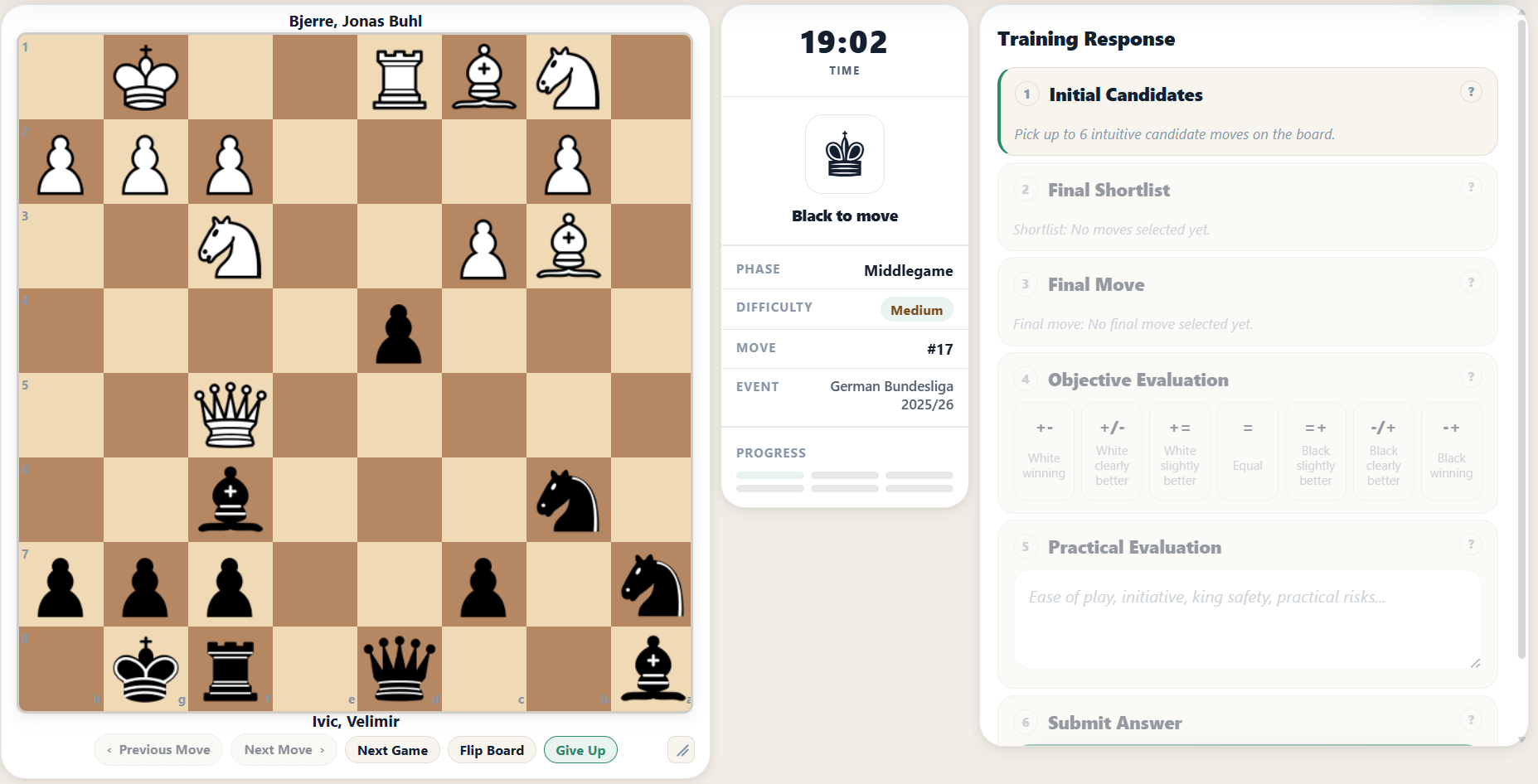
In a real game, you already have context because you played all the previous moves. It is therefore not completely fair to treat this position as an isolated puzzle. Unlike a typical tactical puzzle, you must be reasonable: a simple checkmate is unlikely to be the solution. We are training the thinking process used in real games, where tactics do not arise on every move.
Step 1: Understand the position and your strategy
Before thinking about which moves are good, you need to understand what you are playing for and what your strategy should be. Essentially, you are evaluating the position in a simplified way.
First, zoom out. From the course of the game, you know that White had a slight objective edge in the Spanish opening, while Black remained solid without entering the serious complications that often arise in openings such as the Sicilian.
Now zoom in on the current position while keeping the course of the game in mind. There is clear tension, mostly in the center, and therefore complexity for both sides. But it is not enough to say that the center is tense. That does not yet tell you what Black is playing for. You need to go deeper and apply the evaluation framework.
Here is a simplified application of the framework, excluding the advanced steps.
- The pawn count is equal.
- The pieces are completely equal.
There is no material imbalance.
- Black has six developed pieces, excluding the rook but including the queen on the d-file.
- White has five developed pieces, excluding the bishop on c1 and knight on b1.
Counting developed pieces always has nuances. Although Black has one more developed piece, the bishop on a8 and knight on a7 are passive, while the queen on d8 is not as active as White’s queen on f5. Black’s development advantage is therefore very small, even though it is Black to move.
Lastly, the kingside pawn structure is symmetrical and not especially chaotic. The center is looser for Black because the pawn on d4 is currently hanging.
Step 2: Find all candidate moves
Professionals complete much of Step 1 intuitively through experience. Do not think of the simplified scan as a final objective and practical evaluation. That would require calculation, especially in a balanced position like this one. White may appear to have the typical slight edge, but concrete play is needed to determine which side has the more desirable position in human terms.
Now consider candidate moves. Start with checks, captures, and threats, then move to less striking options such as developing an undeveloped piece or improving a piece in the middlegame. Finally, examine pawn moves, particularly when both sides have already developed most of their pieces.
Black’s striking options include ...Bxf3, ...dxc3, ...g6, and moves such as ...Bd5. In any position, you will find many moves that look striking, but logic should eliminate some immediately. Here, ...dxc3 fails to address the hanging queen, while ...Bd5 simply loses the pawn on d4. Experienced players internalize this process, so the elimination happens much faster.
Next, consider development and improvement moves. Options include ...Nc6, ...Nb5, and ...Re8. Step 1 showed that the pawn on d4 is hanging, so moves that do not resolve that problem are not worth much time. ...Nb5 also hangs the knight immediately. We therefore carry ...Nc6 and ...Re8 forward because they may help solve the problem of the d4-pawn.
Lastly, consider pawn moves that address Black’s problem. ...c5 is the only one that might make sense because it protects the pawn.
Our shortlist is therefore ...Bxf3, ...g6, ...Nc6, ...Re8, and ...c5.
Step 3: Choose a move from your candidates
Now you reach the most difficult part, one that even strong players struggle with: choosing the best move and applying the advanced steps of the evaluation framework.
The most logical approach is another process of elimination. Calculate a few moves ahead for the opponent and your responses to understand where each candidate could lead. At a high level, players also use different heuristics. These may include strategic understanding from similar positions, known positional concepts, or intuition developed over time.
You can immediately eliminate ...Re8 because White can simply play Nxd4, and Black has no back-rank refutation. Experienced players might not even examine this move. ...c5 is the next obvious problem because White can capture with Qxc5, and the follow-up ...Bxf3 does not create enough damage to compensate for the lost pawn.
We are left with ...Bxf3, ...g6, and ...Nc6. I intentionally left these until the end because I could not determine immediately which move was best by calculating only a couple of moves or applying positional understanding.
Naturally, I have reservations about ...Bxf3 because it gives up the bishop pair, so it is unlikely to be the best candidate. ...Nc6 looks logical because it improves the knight and protects the pawn on d4. By comparison, however, ...g6 asks White an immediate question about where to place the queen, while Black can still play ...Nc6 afterward. White’s queen on f5 is ideally placed, so logic suggests that ...g6 is the best move.
We have not yet calculated deeply. More complicated positions can demand much more calculation, and you should not play a move based only on general logic. You should understand what you are getting yourself into.
After ...g6, White can keep the queen on the kingside so that the queen can recapture after ...Bxf3, or play Qc5 to maintain pressure on the d4-pawn and prevent ...c5. White must make a tradeoff.
If White plays Qg4, Black’s next step is not obvious. White has increased the pressure on the d4-pawn, and after ...c5, White can still take on d4. If Black answers ...cxd4, White can recapture with Nxd4.
This is where the mistake in the game occurred. Ivic likely did not understand intuitively how to play around the d4-pawn sacrifice. The correct idea after Qg4 is ...c5, followed by ...c4. After cxd4, ...c4, Bc2, and ...Nb5, Black receives substantial compensation. White’s pieces remain undeveloped, and Black threatens ...Bxf3 followed by ...Nxd4. For instance, Nc3 would allow that sequence, although a professional player would continue calculating from here.
You determine that ...g6 is the best move by going deeply enough into the final candidates and comparing the resulting positions. You cannot always calculate your way to certainty. If I had reached this position myself, I might have made the same initial mistake by missing the idea of ...c5–c4 after Qg4 and chosen ...Nc6, which is still a good move.
Step 4: Make your final evaluation
After this assessment, you have a much better sense of what it feels like for a human to play the position. You can now evaluate it more accurately, both objectively and practically.
Update the simplified evaluation from Step 1 with the advanced considerations and concrete calculation used to choose your move. If your calculation is accurate enough, you will find ...g6 and realize that White does not have an ideal response: White either gives up some central control or allows ...Bxf3, damaging the kingside pawn structure.
I want to be honest: in a real game, I might have played ...Nc6 myself and made a slight mistake. You will never be right 100 percent of the time, but training this process can bring you much closer. Even when you do not find the engine’s first choice, eliminating candidates methodically improves your evaluation and gives you a clearer plan for the moves that follow.
How the process changes in blitz, rapid, and classical chess
Some parts of the structured thinking process require more time than others, which makes mental shortcuts useful at faster time controls.
In blitz, you rarely have enough time to scan the entire board, list every logical option, and eliminate moves one by one. Experienced players therefore use rules of thumb. They may focus on the area of the board where the action is most likely, identify only a couple of strong moves, and choose quickly for practical reasons.
Rapid allows a more deliberate version of the process in critical positions, although you still have to compress the evaluation and candidate stages. In classical chess, you can apply the complete process when the position justifies the time investment. You should still avoid using a long checklist on every move. Save the full process for moments when the position changes, tension must be resolved, or several serious candidates compete for your attention.
Why players repeatedly choose the wrong candidate
Most players do not have a structured thought process, and random move selection makes it impossible to find good moves consistently. Every strong player has a methodology for identifying good or best moves through some combination of understanding and calculation.
Even players with a structured process still make mistakes because of the number of skills involved. You need calculation, pattern recognition, board vision, visualization, fundamental chess understanding, and many other abilities that take a lifetime to improve. The process does not remove this difficulty. It makes the source of an error clearer, so you can identify whether you misunderstood the position, missed a candidate, calculated inaccurately, or evaluated the resulting position incorrectly.
If this repeatedly leads to mistakes in your games, use the blunder diagnosis guide to identify which stage of the process failed.
Frequently asked questions about finding the best move in chess
What should I look at first when choosing a chess move?
Begin by understanding the position rather than searching for moves immediately. Check the material balance, piece placement, king safety, pawn structure, and the opponent’s last move. This gives you a strategy and tells you which kinds of candidate moves deserve attention.
What is a candidate move in chess?
A candidate move is a serious option that deserves comparison or calculation before you decide what to play. Candidates can include forcing moves such as checks, captures, and threats, as well as quiet moves that improve a piece, prevent the opponent’s plan, or support your strategy.
How many candidate moves should I consider?
There is no fixed number. In many practical positions, three to five serious candidates are enough, while forcing positions may leave only one or two. The goal is not to list every legal move. It is to avoid settling for the first attractive move before you have identified the other logical options.
Should I always look at checks, captures, and threats first?
You should scan them first because forcing moves can change the position immediately and may make quieter ideas irrelevant. But “look first” does not mean “play automatically.” After checking the forcing options, compare them with improving and defensive moves that fit the position.
How many moves ahead should I calculate in chess?
There is no useful fixed number. Calculate until the position becomes stable enough to evaluate, the forcing sequence ends, or your available time requires a decision. A short, accurate line that reaches a clear conclusion is more useful than a long variation filled with guesses.
Why can I find the best move in puzzles but not in real games?
In a puzzle, you already know that a tactic or special move exists. In a real game, you must first recognize that the position is critical, understand what both sides want, and generate the correct candidates without a hint. Training complete positions and explaining your reasoning helps transfer tactical skill into practical decision making.
How can I practice finding the best move without depending on an engine?
Use positions from real games and write down your evaluation, candidate moves, calculated lines, and final choice before checking the answer. Then compare your reasoning with a strong player’s explanation, not only the engine’s top line. The important question is not merely whether your move was wrong, but which step of your process caused the mistake.